RisksSlipping KnotsCirculation Restriction Risks & Signs Nerve Damage Risks & Signs Rope Care Rope & Equipment Loading Hygene & Health Risks Personal Fitness & Injuries |
KnotsBoola Boola or Somervill BowlineLarks Head Overhand/Thumb Knot Half Hitch Redirects Reef (Square) Knot Clove Hitch |
EquipmentCarabinersRope Types Suspension Rings |
Western TiesRope CoresetCargo Net |
Shibari (Ground Work)Takate-Kote - Box TieTasuki shibari - Kimono Tie Hishi nawa - Diamond Wrap Kikkou shibari - Tortoise Shell Wrap Ushirode Gassho - Rev. Prayer Hands Ebi shibari - Shrimp Tie Gyaku-ebi - Rev. Shrimp (Hog) Tie Ryou-Ashi Fudou Ippon Shibari - Full Body Ladder Tie |
Zuri (Suspension)Kata-Ashi zuri- One-Leg Hanging Partial Tanuki shibari - Limb Suspension Utsubuse zuri- Face Down Susp. Yoko zuri - Sideways Suspension Aomuke zuri - Face Up Suspension Sakasa zuri - Inverted Suspension |
Showing posts with label basic. Show all posts
Showing posts with label basic. Show all posts
Tuesday, 23 December 2014
Kinbaku Syllabus
Just a list of what I think people should learn to develop a basic toolkit of Kinbaku skills & patterns.

Other Useful Knots
These are just knots your proably should know;
- Reef (Square) Knot
- Clove Hitch (with the end or loops)
- Tape Knot (Water Knot)
- Figure 8 Knot (basic and other forms)
- Alpine Butterfly
Saturday, 13 December 2014
Rope Selection
Just a few thoughts on the relative merits/costs of Rope Selection. I also found a good reference on issues facing rope selection.
| Rope |
Size (mm) |
Material | Break Load (kg) |
Cost (A$) |
Cost/m |
Cost 8m |
Comments |
| 300m Jute Twine | 1 | Jute | 10.00 | 0.03 | 0.24 | Can be used for hand tieing or homemade rope making |
|
| 6mm x 20m Cotton Sash Cord | 6 | Cotton | 15.00 | 0.75 | 6.00 | Good for practice rope. High eleastisity. Stretches. |
|
| 8mm x 15m Cotton Sash Cord | 8 | Cotton | 17.50 | 1.67 | 9.33 | High eleastisity. Stretches. | |
| 6mm x 30m High Strength Rope | 6 | Poly- propolene |
Break 650kg |
23.00 | 0.76 | 6.13 | Suspension Main ? |
| 8mm x 30m High Strength Rope | 8 | Poly- propolene |
Break 1200kg |
35.00 | 1.67 | 9.33 | |
| 6mm White Super Silver Rope | 6 | Synthetic | 0.45 | 3.60 | Cheap Twisted Practice Rope | ||
| 8mm x 20m White Super Silver Rope | 6 | Synthetic | 13.50 | 0.68 | 5.40 | Cheap Twisted Practice Rope | |
| Ichiban Light jute rope 6mm, 1 x 8m | 6 | Jute | 18.94 | 2.37 | 18.94 | ||
| Asanawa shibari kinbaku jute rope 7mm,1 x 8m |
7 | Jute | 22.75 | 2.84 | 22.75 | High Quality Treated Jute | |
| Natural Hemp Rope Twisted 6mm per m Unconditioned | 6 | Organic Hemp | Break 260kg |
1.55 | 12.40 | ||
| Natural Hemp Rope Twisted 8mm per m Unconditioned | 8 | Organic Hemp | Break 410kg |
1.80 | 14.40 | ||
| Mammut Static Cord 2mm per metre | 2 | Synthetic | Break 50kg |
0.50 | 4.00 | For accessories | |
| Mammut Static Cord 6mm per metre | 6 | Synthetic | Break 810kg |
1.80 | 14.40 | ||
| Mammut Obsession 8.3mm 50M PAIR Dynamic Climbing | 8.3 | Synthetic | 6.5kn (662kg) Impact Force 9 UIAA falls |
400.00 | 4.00 | 32.00 | |
| Mammut Galaxy 10mm X 60metre Dynamic Climbing | 10 | Synthetic | 9.2kn (937kg) Impact Force 7 UIAA falls |
300.00 | 5.00 | 40.00 |
Ref
These suppliers are only included as references to this table and not for any endorsement or commercial purposes.- Bunnings (general)
- Esinem (jute)
- Jade Rope (hemp)
- Mountain Designs (climbing)
Saturday, 7 May 2011
Tape Knot Teaser
Back from my rock climbing days we used to make our own slings from 25mm tube tape. This is available from most adventure stores at least in Australia at a price quite reasonable when compared to premade slings.

As you can see from the photo there are no lose ends from the doubt tape knot in the completed loop (like in my previous post on the Tape Knot) even though it was made from a simple length of tube tape.
When I was first shown this ... I was told I had to work it out for myself !!!
I set the same challenge to you all.
Would love to hear some feed back if others use this method to make loops and if you don't how long it took you to work it out. Its not rocket science but a bit of ropey fun.
Feel free to beg if you just don't get it :>
Wednesday, 4 May 2011
Tape Knot
This is a basic knot for tying lengths of tape (seat belt material) together. The white tape below is 25mm tube tape but it can be applied to 50mm single tape or any other flat sort of material.
This knot is also how I used to finish tying the tape harness I used for my complete rock climbing career. Being a poor uni student 5m of 50mm tape was significantly cheaper then a dedicated harness.
I will do some later posts showing how to tie a tape harness and a fun challenge to tie a tape loop without tails!

The knot is basically the overhand knot tied in a flat style started above and completed loosely below.


The knot can be kept in a flat style above or tightened as below

Another use for the tape knot is to joint two ends of tape to form a loop. The basic theory is to tie a single tape knot as above and then feed in the other end or length of tape where the first end exits the first tape knot.

Tie a loose tape knot

Feed in the other end/second tape where the first end exits the knot.

Follow the knot around.

Exit the first tape knot at the long end.

Tighten up the knot.

The final loop with lose ends.
Monday, 4 April 2011
My Book List
This is a List of my bdsm books (sorta in order of preference). These are just my personal preferences and no reflection on the authors or the work I know that goes into the preparation of original work. Note that not all the books are about bondage as there is more to the Ds dynamic then rope (shock horror I know!)
First Choice
First Choice
- Arisue's Go's Kinbaku Mind and Techniques 1
- Arisue's Go's Kinbaku Mind and Techniques 2 (Floor Works 1)
- Beauty of Kinbaku - Master K
- Douglas Kent's Complete Shibari Volume 1 Land
- Douglas Kent's Complete Shibari Volume 2 Sky
- The Seductive Art of Japanese Bondage - Midori
- Back on the Ropes - Two Knotty Boys
- Screw teh roses Send me the Thorns - Miller & Devon
- Rope, Bondage, Power - Lee Harington
- Bondage for Sex - Chanta Rose
- Shibari you can use - Lee Harington
- Wild Side Sex: The Book of Kink - Midori
- KinkyCrafts: 99 Do-it-youself S/M Toys - Green & Easton
- SM101 - Jay Wiseman
- Radical Ecstasy - Easton & Hardy
- Master's Manual - Jack Rinella
- The Control Book - Peter Masters
- Protocols: a Variety of Views - Bob Rubel
- Master Slave Relations - Bob Rubel
- Art of Slavery - Bob Rubel
- Erotic Slavehood - Christina Abernathy
- New Bottoming Book - Easton & Hardy
- New Topping Book - Easton & Hardy
- Showing you the Ropes - Two Knotty Boys
- Errotic Bondage Handbook - Jay Wiseman
Saturday, 26 March 2011
Kinbaku, Hojojutsu, Shibari, Fusion and Western Bondage
You way well wonder what are let alone the difference between Kinbaku, Hojojutsu, Shibari, Fusion and Western Bondage. I think you can probably ask three rope experts(?) and come up with at least five different answers. So I guess I will add mine ...
Kinbaku - I see this as the pure traditional form of Japanese sensual bondage. The forms are well defined and referenced in many places so I wont go into detail here but will document my own ties as I learn them. I am often asked "Whats the difference to Shibari ? Isnt this just Shibari?" ... to me the difference to me is like learning Karate in Okinawa to learning it in LA. Yes they are sort of the same but also intrinsically different at a philosphical and spiritual level.
Hojojutsu - is the martial art of subbuing and binding prisioners based upon the practices of feudal Japanese warriors. There are many similarities and ties to jojitsu and ninjitsu. Perhaps not exactly correct but its the way I see it.
Shibari - is a more westernised approach to Kinbaku. Not so much focused on form but just the general sorts of ties you see documented in most bondage books. Probably more focused on sexuality then perhaps sensuality and further removed from the traditional martial origins.
Fusion - I see as being even further removed from the eastern origins and more focused on fancy knot work. I am not sure of the source of the knots but I would suspect more decorative areas such as macrame and yachting :)
Western Bondage - (or dont care just tie the bitch) is the fine art of functional bondage. Form and style have given away to functionality and speed. Its the means to another ends rather then the art itself. Again perhaps not everyones view on it but this is mine.
Tuesday, 22 March 2011
Rescue Hook or EMT Shears

- Small compact size.
- Simple to use.
- Less components to fail.
- Opens beer bottles (after roping!)
The plastic rescue hook (on the right) is similar in ease of use to the Benchmade hook. It has advantages of replaceable blades which are razor sharp. But down side of more bits to break when you need them most.
EMT shears (on the left) are my last choice as they arent so simple to cut rope. Admittedly they are less likely to unintentionally cut someone through mishandling then rescue hooks (yes I have accidentally nicked myself with rescue hooks) but I also see various quality shears around which I think you really do not want to rely upon in an emergency situation.
Thursday, 17 March 2011
Rope Types
I was going to write an article on rope types but I found a good article by erinhoudini who also supplies interesting dyed nylon solid braid. So I guess I might talk about why I use particular ropes.
Jute/Hemp
Is my first choice of rope for the way it feels and affects a rope bottom. The best description I have heard from a bottom is that "it is like being wrapped in croncrete". This is due to the low deflection under load which makes for better bondage and knotting. I rather the lightness of jute compared to hemp.
Synthetic
I mostly use this if I can find one supple enough to hold knots such as climbing rope. Often synthetic rope from hardware stores just doesnt have a nice feel or knots securely. Climbing rope also has the advantage of being load rated. Synthetic rope does also come in nice colours.
Cotton
I mostly use this rope as a disposable rope for practice or where there is risk of contamination. It realy just does not knot nicely as they tighten and stretch under load.
Monday, 14 March 2011
Three Knots to Bind Them All

- Larks Head Knot
- Overhand or Thumb Knot
(tied to the rod with a clove hitch) - One/Two Column Tie
Esinem has a good discussion and tips on the Boola Boola.
Before you can say I cant count there are four knots. Well the last one is a personal preference and to be honest you can get away with just learning the Boola Boola. The Somerville Bowline is just a bit smancey.
Before you can say I cant count there are four knots. Well the last one is a personal preference and to be honest you can get away with just learning the Boola Boola. The Somerville Bowline is just a bit smancey.
Basic Hair Tie
This tie is based upon Twisted Monk's Basic Hair Tie Video. My variation has more wraps as I find single wraps tend to slip in a subs hair. Optionally you can skip the last step if you want to leave the initial knot unlocked with the tail through the rope loop.
As in Monk's video I am using 4mm rope (jute in my case as is my perference )but as he didnt mention rope length. I have used one about 3m long. Long enough to tie the hair and tie off to somewhere else like ankles or a chest harness. 4mm is used because its more flexible and not as heavy. You can go smaller say to 2mm spectra or 6mm to incorporate into another tie if the subs hair is not too fine.

Make a bight (loop) in the middle of the rope
and grab the hair in a ponytail

Wrap the bight end of rope around the hair two times

Tie a simple overhand knot
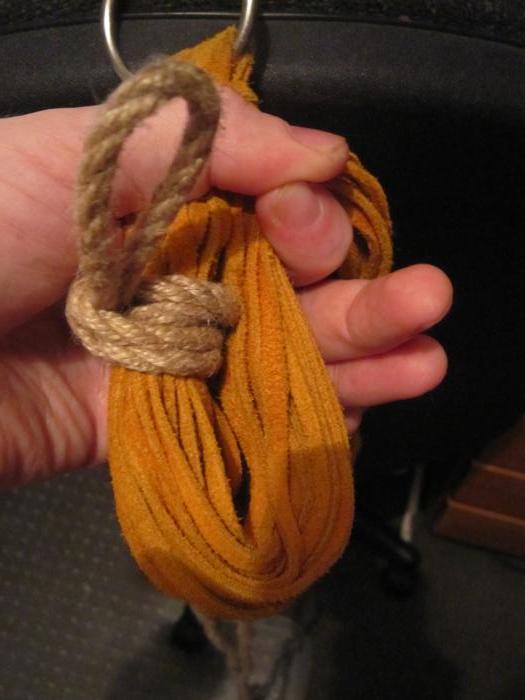
Make a loop from the hair
 |  |
Wrap the tail (loose) end around the hair loop two times
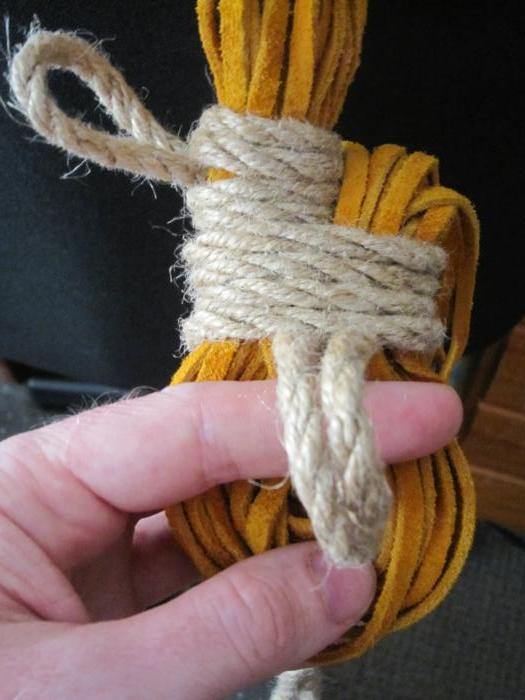 |  |
Poke the tail through the hair loop
 |  |
Secure though rope loop
Subscribe to:
Posts (Atom)